Our current order processing time is: 1 business day.
We sell B2B only. In most states, a signed sales tax exemption form is required to purchase. Our minimum order is $125.

Inspiration & Education
DESIGN GALLERY
If a picture is worth a 1000 words, then this is the most valuable section of our site! Get inspired by beautiful designs!
DESIGN VIDEOS
View our design videos for the latest tips and tricks for the industry.
BLOG
Check out our blog for the latest articles on tips and tricks for the industry.

The Reality of Real Touch
Because silk flowers are more lifelike and economical than ever, many floral designers are realizing the benefits. However, you might be persuaded to use the “real touch” variety, thinking it will always be the highest quality and realistic choice for your customers. This isn’t the case!
The term “real touch” begs the question – “Is your customer going to touch this flower?” If the answer is no, then a real touch flower isn’t appropriate.
Consider your design application, and the price you and your customers are willing to pay. If the flowers will be viewed near or far, in events or at home, choose flowers that provide the look, movement, and stability needed.
A quality silk flower delivers all of the principles and elements of floral design, regardless of it being deemed “real touch.”
What is a “real touch” flower?
An artificial flower that is labeled “real touch” means that it is made of a special material polyurethane (plastic) or latex petals that have a fleshy, velvety, feeling.
What flower varieties are made in “real touch” material?
“Real touch” material is most often used in calla lilies or orchids- flower varieties that naturally have larger, smooth, petals. These 1-3 petal flower varieties have petals that are large and curve, almost appearing hand-molded, making them a variety that works well with this soft formed plastic.

Why should I design with “real touch” flowers?
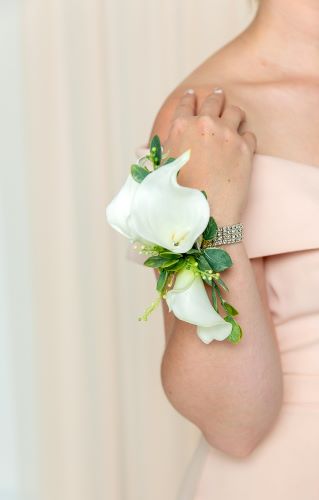
If a customer is going to be actually touching the flowers, like in a wedding bouquet, corsage or boutonniere, many floral designers will want to use an artificial flower that feels as much like the original as possible.
However, if the flower is not going to be physically touched, like most event and décor floral design, real touch varieties can add unneeded cost and fragility.
Where is it problematic to use “real touch” flowers?
Real touch flowers are made with delicate materials.
For wreathes, real touch often does not stay as securely as other silk flower varieties with stems designed for insertions in the wreath base. “Real touch” stems are designed to be touched.
They are not recommended for outdoor use. Additionally, they are not colorfast and may fade or yellow over time.
What if a flower isn’t “real touch”?
Artificial flowers do not need to be labeled “real touch” to appear realistic.
A flower variety, such as hydrangea, that is made of hundreds of small, feathery petals, should be made with a fabric, not polypropylene, to provide the most realistic look, movement and texture.
“Real touch” does not apply to the touch of ALL flowers. A peony, for example has layers of thin petals and fringe edges. To feel real, you need a material that is thin, silky and soft, not thick, rubbery and plump like “real touch” petals.
To choose the best-looking artificial flower, there are some basic rules to follow. Expert David Botchick shares more here.
Why don’t you sell more “real touch” flowers?
We believe the most realistic looking artificial flowers use materials that look like the real variety. This means that we match the color and texture of the real plant, knowing most customers will not be touching the petals. We strive to provide our customers with the highest quality, easy to use, and cost-effective artificial flowers and foliage for any design.
A Collaboration from Sarah Botchick of Pioneer and Blog Writer Laura Vitale.

